Posts

Showing posts with the label BEST

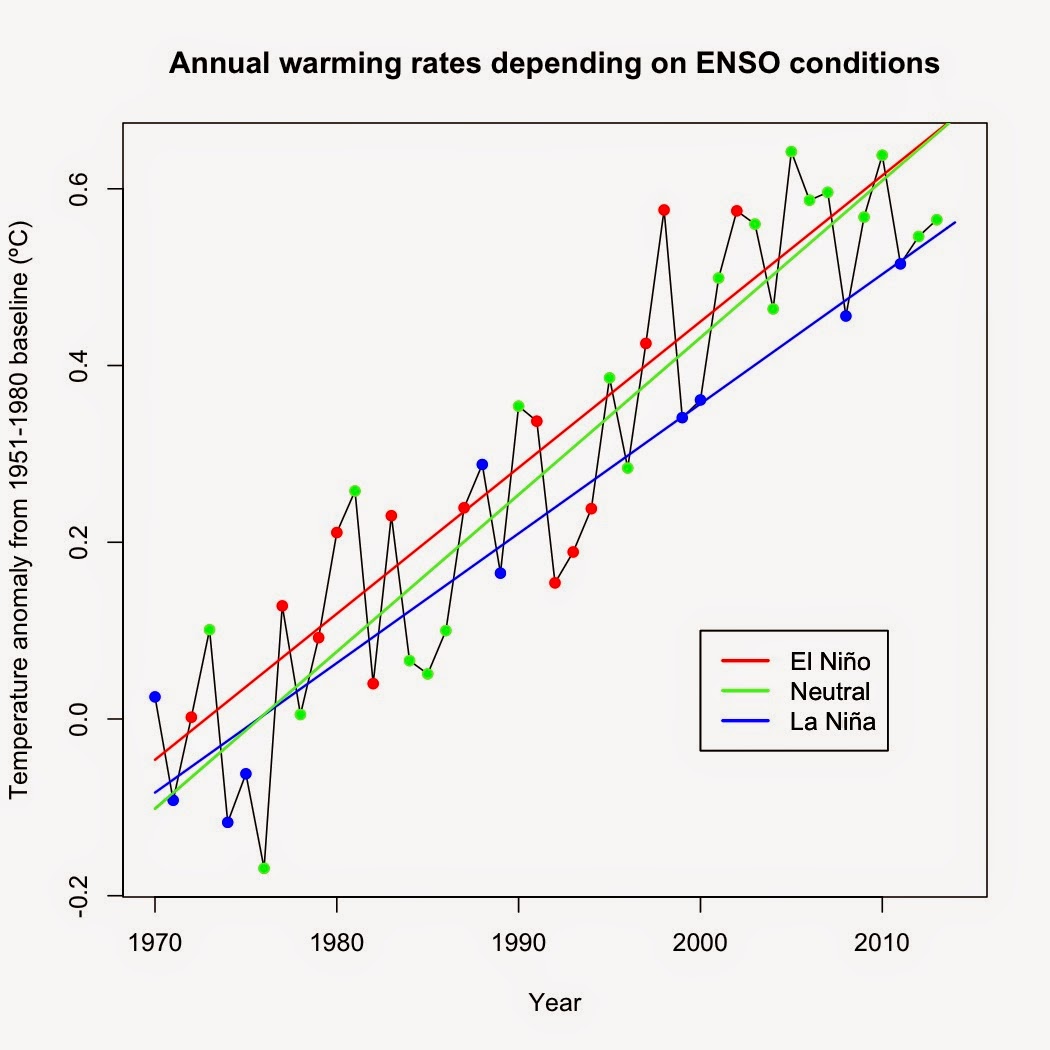
A prediction of global surface temperatures if an El Niño forms this year.
Image
There are increasing evidence that we'll have our first El Niño since 2010 sometime within the next year.  Just for fun, I thought it would be interesting to try to predict what the annual global average temperature would be if an El Niño developed as expected. I took Berkeley Earth land + ocean annual temperature data starting in 1970 and categorized each year as El Niño, La Niña, or neutral using average MEI data for each year.  Any year with an MEI average  ≥ +0.5 was classed as an El Niño year.  La Niña years had MEI values ≤ -0.5, whereas neutral years were between -0.5 and +0.5.  I then performed a separate linear regression on each category.

New Berkeley Earth temperature dataset vs existing datasets

Image
The Berkeley Earth team released a new temperature analysis that includes both land and ocean surface temperatures .  They used their existing land data and merged it with HadSST data (note: not HadSST3 as I originally wrote), using kriging to interpolate temperatures where data did not directly exist.  In this, their methodology is similar to the recent Cowtan and Way ( 2013 ) paper, however, Cowtan and Way used HadSST3 for their ocean data.  I've compared their new results over the past 30 years (Jan 1984-Dec 2013) to GISS, HadCRUT4, NCDC, UAH, and Cowtan and Way's results, first standardizing all temperature anomalies to the 1981-2010 baseline.  Why the past 30 years?  Thirty years is generally considered the standard time period for measuring climate.  All trends mentioned in this article are calculated using linear regression corrected for autocorrelation.