Posts

Showing posts with the label nitrogen cycle

Crossing the boundaries

Image
In 2009, a paper was published that measured where humanity stood in respects to the safe operating boundaries for nine environmental parameters ( Rockström et al. 2009 ).  The nine they chose were climate change, ocean acidification, stratospheric ozone depletion, rate of biodiversity loss, biogeochemical cycles (specifically, the nitrogen and phosphorus cycles), global freshwater use, change in land use, atmospheric aerosol loading, and chemical pollution.  Using the Holocene as a baseline, they calculated threshold levels for each parameter that, when crossed, created a high risk for changes that would be damaging for human civilization.
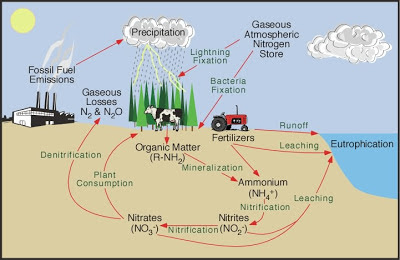
The Nitrogen cycle—another natural cycle we've altered

Image
Nitrogen is an essential element for all life, as it's a major component of amino acids (proteins) and nucleic acids (DNA and RNA).  The main pool of nitrogen is the atmosphere, comprising 78% of the atmosphere as nitrogen gas (N 2 ).  Unfortunately, plants cannot use N 2 directly.  It must be converted to either ammonium (NH 3 ) or nitrate (NO 3 - ) before plants can absorb it and incorporate it into amino acids and nucleic acids.  In nature, most nitrogen conversion is done through a process known as nitrification wherein N 2 is converted first to NH 3 by several genera of nitrogen-fixing bacteria and cyanobacteria, then to NO 2 -  (nitrite) by bacteria in the genera Nitrosomonas or Nitrococcus , and finally to NO 3 - by bacteria in the Nitrobacter genus.  Nitrate that isn't absorbed by plants is returned to the atmosphere by the process of denitrification, wherein nitrate is converted to N 2 gas by denitrifying bacteria.