Posts

Showing posts with the label ARMA

Revisiting the question of "Has global warming stopped since 1998?"—again.
Image
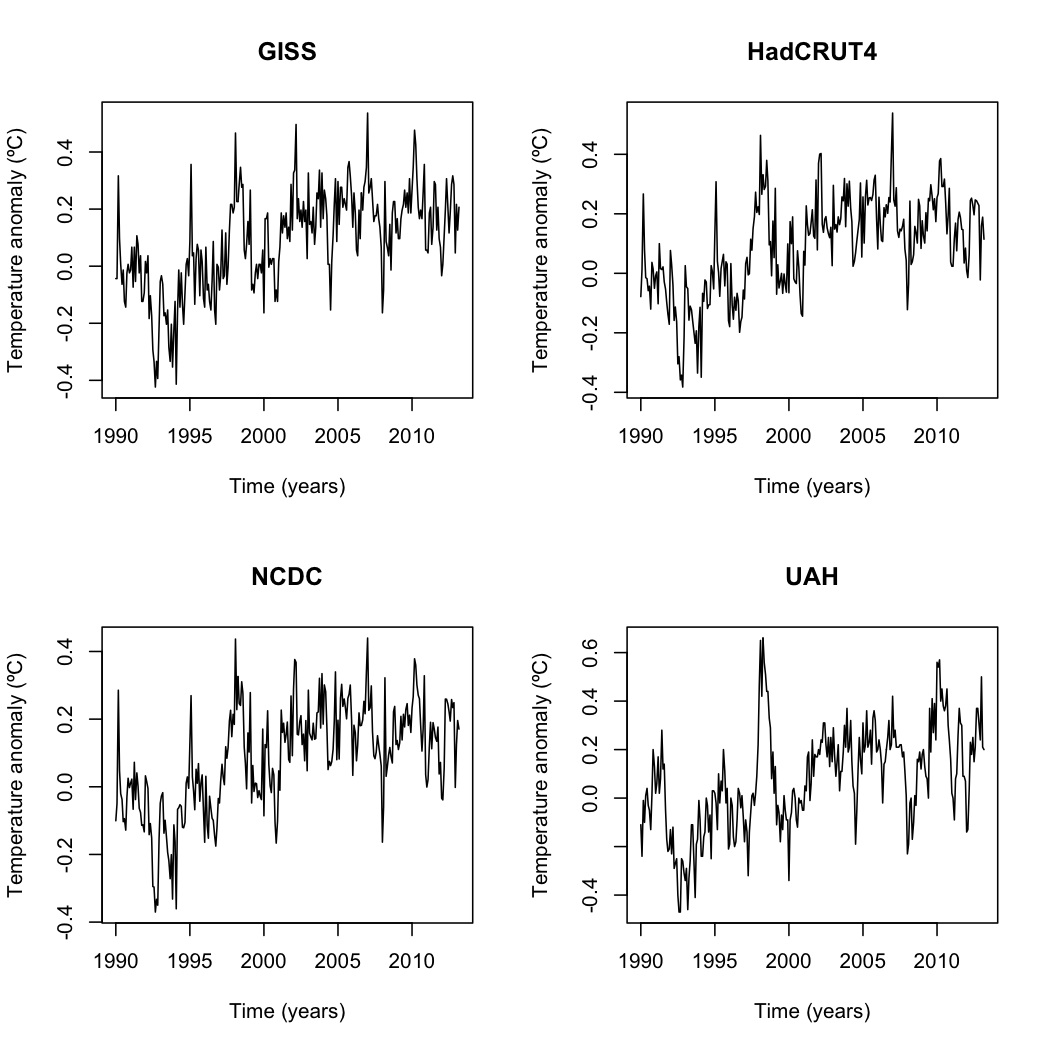
Let me be blunt: There is little evidence that global warming stopped in 1998 or any year thereafter.  Most of the evidence we have, from the energy imbalance to total heat content to ocean heat content, show that global warming continues, as I previously explained here , here , and here .  The only piece of evidence that appears to show that global warming has stopped is that the trend in surface temperature data is not statistically significant in recent years.  However, that is at best ambiguous.  No significant trend could mean that warming continues but short-term variation in the data masks the trend, that there's no warming or that there's a cooling trend but not enough data for that to be significant.  There's no real way to tell unless you either a) add enough data for short-term variation to cancel out or b) use statistical techniques to factor out the known natural variation. In this article, I expand on my previous analyses of surface temperature, ...

Compensating for autocorrelation in global temperature data

Image
Autocorrelation in global temperature data simply means that the average temperature for any one month is correlated with the average temperature of the previous month.  It is an unfortunately common problem when dealing with time series and spatial statistics.  The gist of the issue is that most of the standard statistical analysis techniques such as ANOVA, regression, and the like assume that variation in the data is random or white noise when calculating standard errors and p-values.  Autocorrelation means that the noise in the data is not random but correlated or red noise.  The degree of correlation reduces the effective size of the data set and means that the standard errors and p-values calculated from normal statistical tests will be lower than they should be and biased toward showing statistical significance when in reality the tests should not show significance. One of the best ways to compensate for autocorrelation is to use an Autoregressive Integrated ...