Posts

Showing posts with the label global warming stopped in 1998

A pause in global warming? What pause?!?

Image
Much has been made of the pause in global surface temperatures since 1998.  Among the factors advanced to explain that pause include a change in ENSO, a decline in solar output, and an increase in aerosols (i.e. Foster and Rahmstorf 2011 ).  One of the previously neglected factors is artificial cooling in global surface temperature data sets.  Neither the HadCRUT4 nor the NOAA temperature data cover the polar regions.  As the polar regions are the fastest warming areas on Earth (UAH Arctic trend since November 1978: +0.44ºC per decade, Global trend: +0.14ºC per decade), excluding those regions leads to an artificial cooling bias in the data. Anomaly map of HadCRUT4, showing the gaps in data coverage (in white) Both NOAA and GISS are artificially cooled by an outdated ocean temperature data set (HadSST2) that doesn't account for the change from ship-based temperature measurements to buoy-based temperature measurements that occurred within the last 10 years ( ...
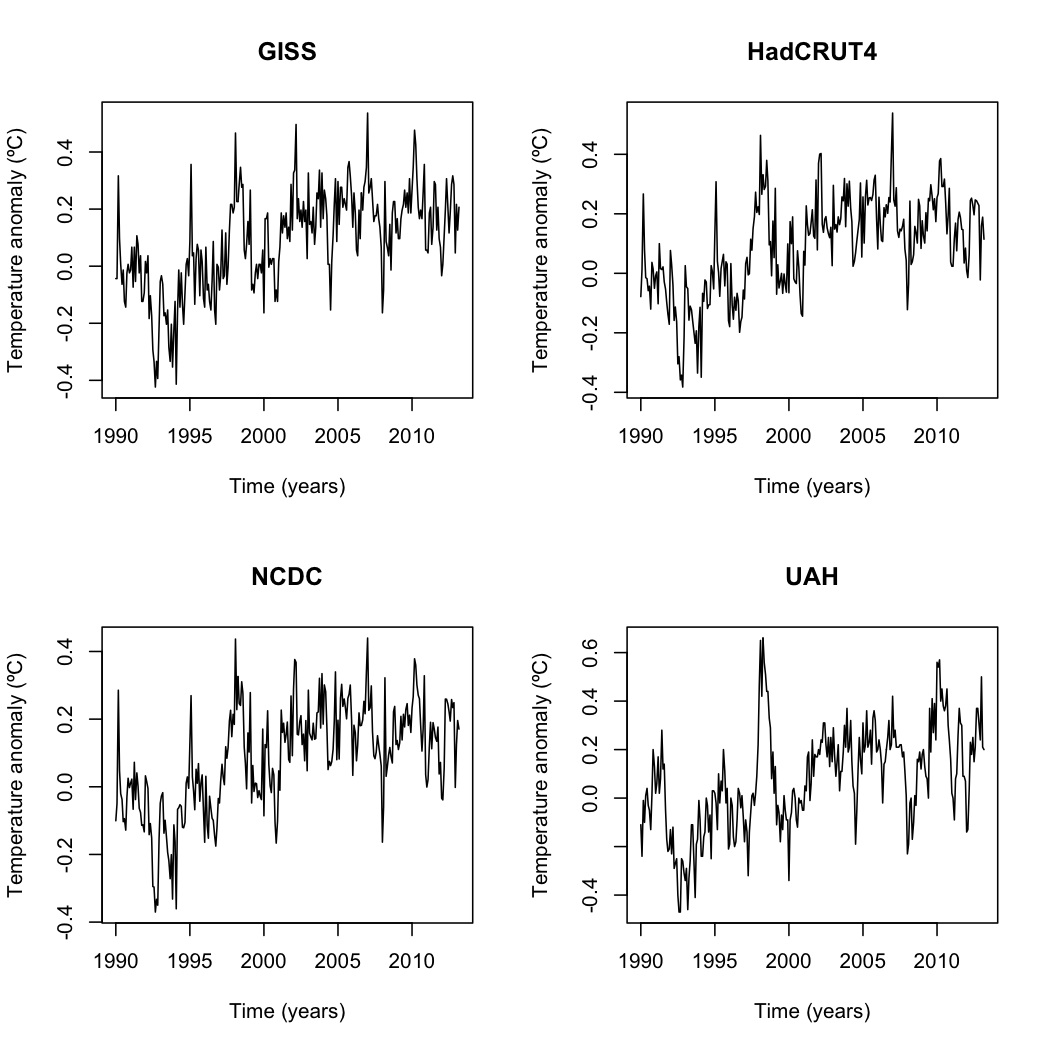
Revisiting the question of "Has global warming stopped since 1998?"—again.

Image
Let me be blunt: There is little evidence that global warming stopped in 1998 or any year thereafter.  Most of the evidence we have, from the energy imbalance to total heat content to ocean heat content, show that global warming continues, as I previously explained here , here , and here .  The only piece of evidence that appears to show that global warming has stopped is that the trend in surface temperature data is not statistically significant in recent years.  However, that is at best ambiguous.  No significant trend could mean that warming continues but short-term variation in the data masks the trend, that there's no warming or that there's a cooling trend but not enough data for that to be significant.  There's no real way to tell unless you either a) add enough data for short-term variation to cancel out or b) use statistical techniques to factor out the known natural variation. In this article, I expand on my previous analyses of surface temperature, ...