Posts

Showing posts with the label global temperature

Climate of 2016 to date
Image
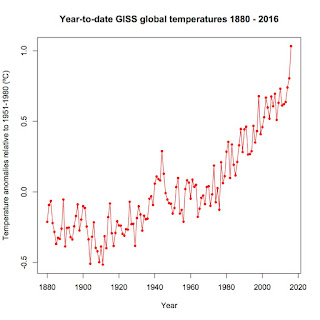
No, I'm not talking about the recently concluded US election that saw a scientific illiterate ascend to the presidency. Given the lack of details about Donald Trump's intended policies, it's impossible to say what, exactly, his election means for science in the US although I have doubts that it means anything good given his stated antithesis toward science, particularly climate science. I will instead focus on some significant events that have been eclipsed in the media frenzy around the presidential campaign. First up, global temperature. Has it been hot enough for you? Here are January through September temperatures for every year in the GISS record.  So far, 2016 has obliterated the previous record for January - September global temperature anomaly set in 2015, 1.03ºC to 0.80ºC. Not only is the average for the first nine months hotter but eight of those months are the hottest respective months on record, with only June 2016 (in third place) the lone non-record-sette...

Where is climate change headed?

Image
With the completion of yet another circle around the sun, it's time to take stock of where we're headed with global climate.  I'm going to do something that is somewhat risky—extend statistical models beyond the data range that was used to create them, but necessary if we want to see where current trends will take us in the future.

Global warming: Carbon dioxide vs. Natural cycles

Image
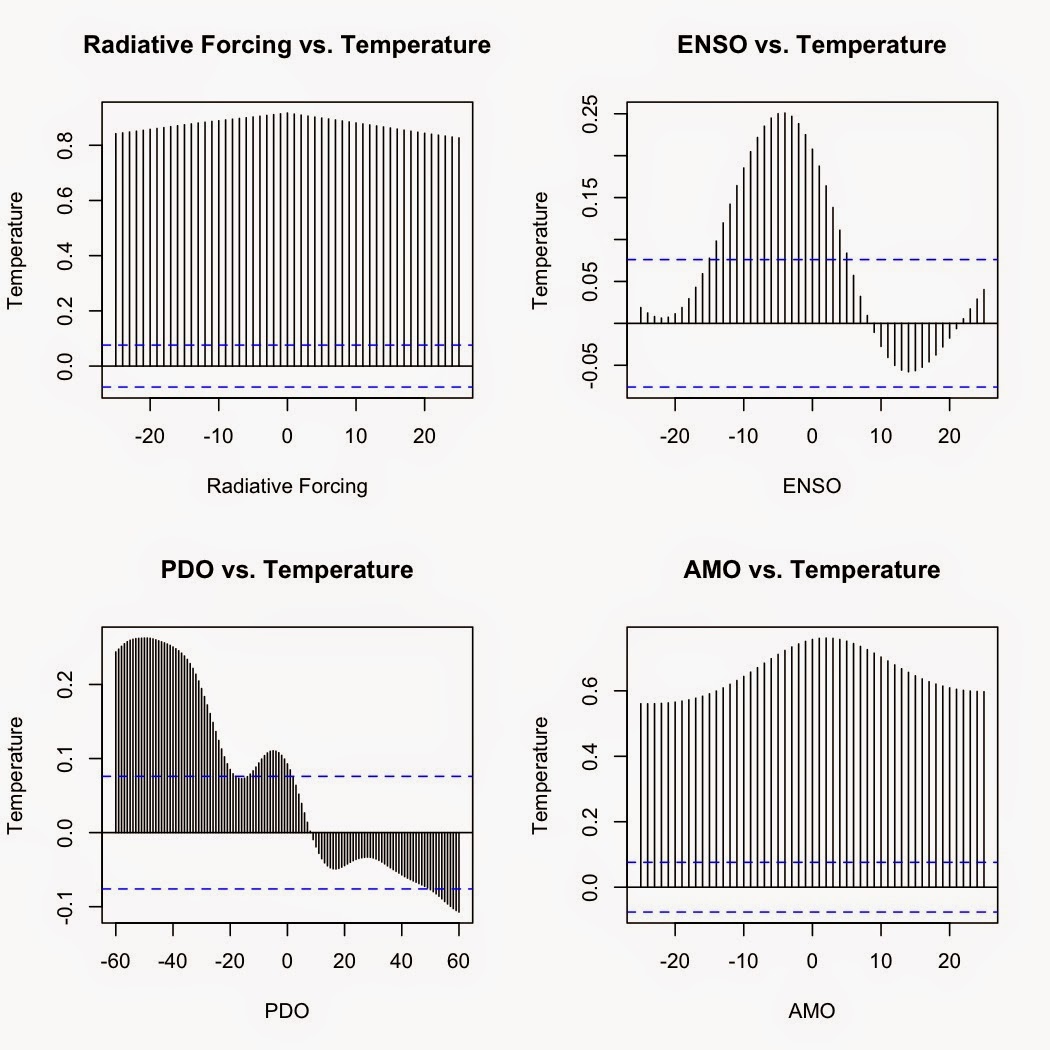
The recent paper by Johnstone and Mantua ( 2014 ) has certainly made the rounds in conservative circles.  It's popped up several times on my Facebook feed as various friends and acquaintances share articles about it.  Unfortunately, most of those articles get it wrong, usually twisting Johnstone and Mantua's findings to imply that 80% of ALL global warming is natural.  As I explained in my last post , that is a blatant misinterpretation of their paper, which only applies to the northeastern Pacific and coastal regions of the US Pacific Northwest.  Globally, natural cycles do not explain the trend in global temperatures.  How can I say that?  Do the statistics.

Where does 2014 rank in the hottest years on record so far?

Image
While we're closing in on September, several of the global temperature datasets are still stuck on June and haven't released the July data yet.  Just for fun, let's compare how the first six months of 2014 stack up to previous years.  To answer the question in the title, I  averaged the first six months of each year in the Cowtan-Way global temperature dataset.

A prediction of global surface temperatures if an El Niño forms this year.

Image
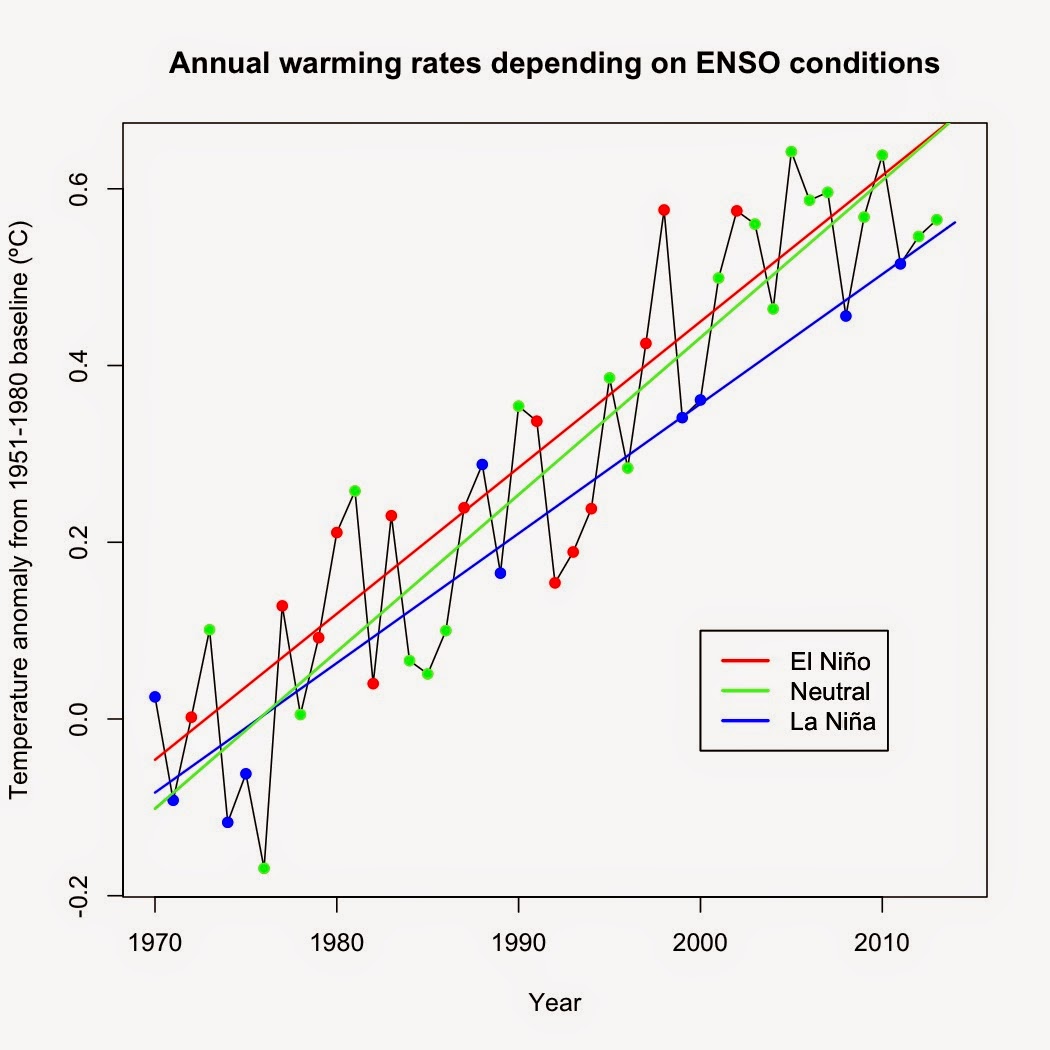
There are increasing evidence that we'll have our first El Niño since 2010 sometime within the next year.  Just for fun, I thought it would be interesting to try to predict what the annual global average temperature would be if an El Niño developed as expected. I took Berkeley Earth land + ocean annual temperature data starting in 1970 and categorized each year as El Niño, La Niña, or neutral using average MEI data for each year.  Any year with an MEI average  ≥ +0.5 was classed as an El Niño year.  La Niña years had MEI values ≤ -0.5, whereas neutral years were between -0.5 and +0.5.  I then performed a separate linear regression on each category.

2013 climate review

Image
2013 was notable in several ways, from the record warmth in Australia to the polar vortex that gripped the Eastern US in November and December due to a weakened Arctic polar jet stream and record drought in the US state of California, along with numerous extreme weather events around the globe .

Solar influence on climate change

Image
The degree to which the sun impacts climate change is hotly debated, mostly in climate change denier circles, with claims that the current warming is due to the sun.  That claim, however, ignores the actual science.  There have been multiple research studies published since 1998 that show that the sun has very little to do with the current global warming episode.  Solanki et al. ( 2004 ), Usoskin et al. ( 2005 ), and Scafetta and West ( 2006 ) used reconstructions of solar activity to show that the sun contributed little to warming since the 1970s.  Lockwood and Fröhlich ( 2007 ) showed that trends in solar output and activity since 1988 are opposite what would be required for the sun to cause global warming.  Meehl et al. ( 2004 ), Ammann et al. ( 2007 ), and Huber and Knutti ( 2011 ) used climate models to show that solar output and other natural climate forces could not replicate the observed temperature trend without adding anthropogenic carbon dioxide....