Posts

What are the odds that 2015 will not be the hottest year on record?

Image
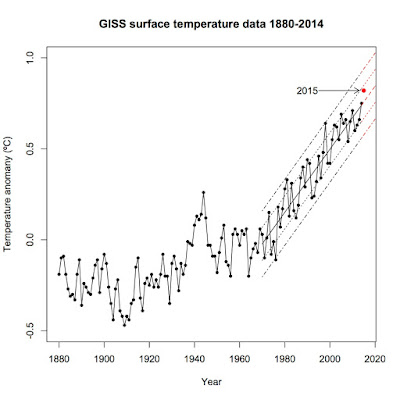
Let me be upfront with you: I think it's a foregone conclusion that 2015 will beat out 2014 as the hottest year on record. However, I decided to test that idea, just to be certain. The way I did it was simple: I first calculated the year-to-date average (January - July) and then calculated what the August — December average would have to be to keep the 2015 average temperature at or below that of 2014. I then calculated the August — December average for each year since 1970, fitted a trend, and calculated the standard deviation of the residuals. Last, I calculated the expected August - December average for 2015 given the trend and the difference between the expected August - December average and what that average would have to be to keep 2015 from setting a new record.  I then used z-scores to calculate the probability that the remainder of 2015 would fall to that level or below. Annual global temperature according to NASA GISS since 1970 Year to date, 2015 sits at +0.82...

Global warming, The Wall Street Journal, and John Gordon

Image
John Steele Gordon published a commentary in The Wall Street Journal on July 30 that, on its face, sounds reasonable.  Gordon makes the case that we should be cautious about calling climate science settled as science is always changing.  No real quibbles there, as science has shown that nothing is ever truly "settled" science.  Unfortunately, that's as close to reality as Gordon comes.  The rest of the commentary simply shows off Gordon's simplistic view of history, science, and, especially, the current state of climate science.

Hottest first six months on record

Image
I know, I know, I'm behind a bit.  Most of the stories on the first six months of this year came nearly a month ago.  Better late than never.  By now, we all know that the world is headed toward its hottest year ever, breaking the record set just last year.  In this post, I'm going to analyze just how abnormal normal the first half of the year has been.

James Taylor gets polar ice wrong—as usual

Image
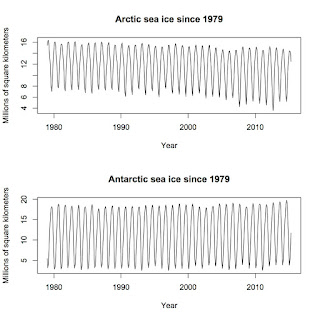
James Taylor of the Heartland Institute had a piece on Forbes back in May that escaped my attention when it first came out.  Titled " Updated NASA Data: Global Warming Not Causing Any Polar Ice Retreat ", it focused on the single premise that since 2012, total polar sea ice was above the average since 1979.  Taylor then jumped to the erroneous conclusions that a) polar sea ice was not retreating and b) global warming will be entirely beneficial to humans.  His arguments are familiar, as I dealt with them before when a Newsmax article featured them back in 2014 .  He's recycling old talking points, so this post is going to echo the one I wrote a year ago.

The Ice Age Cometh?

Image
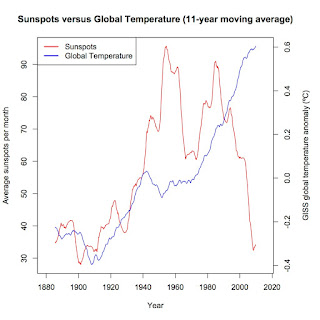
Recent media reports have claimed that a drop in solar activity will lead to a mini-Ice Age within the next 15 years.  Unfortunately, even press reports from science-related media such as Science Daily , have been riddled with errors. Let's get the biggest one out of the way first.  Zharkova et al. ( 2015 ) did not predict a new Little Ice Age (LIA).  What they did was use principle component analysis to detect and model magnetic waves within the sun.  They found that there were two such waves, each with an 11-year cycle, that either interfered with each other when sunspot activity was low or magnified each other when sunspot activity was high.  They then ran their statistical model ahead to make a prediction for the next solar cycle and found that their model predicts that the waves should cancel each other out, resulting in their subsequent prediction that solar activity should drop to levels not seen since the Maunder Minimum.  That bit about the Maund...

US versus global temperatures

Image
One of the talking points I see (and hear) time and again here is the question "If the world's getting hotter, why is it cold here?", "here" usually referring to the eastern United States.  Another variation goes "Global warming can't be happening because US temperatures haven't risen in _____ years."  Yes, it's the good old "It's cold in my backyard so the planet can't be warming up" argument. Here's why it's dead wrong.

The "hiatus" doesn't exist.

Image
That is the conclusion of a new study published in Science yesterday.  Tom Karl and his co-authors used a newly available database of weather station data that combined the Global Historical Climatology Network (GHCN) used by NOAA and NASA with over 40 other historical data sources, effectively doubling the size of the available land temperature data set.  They applied the same corrections for changes in location, urban heat island effect, etc as with the GHCN-only data set and used the same algorithms to calculate the global average over land.  To get a global average, they used the Extended Reconstructed Sea Surface Temperature dataset version 4 (ERSST4), which better integrates ship-based temperature data and buoy-based temperature data, and merged it with their new land data.  Karl et al. then created a third global temperature average that also fills in the gaps between weather stations in the polar regions. Their new data set shows much higher trends than th...