Posts

Showing posts with the label Arctic sea ice

Meltdown: An early prediction of September 2017 Actic sea ice extent

Image
Yes, I'm a bit late but the Arctic is in full meltdown this year. I crunched the numbers for April ice extent and found that this past April saw the second-lowest Arctic sea ice extent on record. Since 1979, average sea ice extent in April has declined by 1,403,600 square kilometers, an area nearly the size of Alaska and over twice the size of Texas. (Alaska has an area of 1,717,854 square kilometers and Texas comes in at 696,241 square kilometers. You can find a list of all 50 states at ThoughtCo.com in case you're curious). Even more worrisome is the record low average extent in the first four months of this year. Average monthly January to April extent has fallen by 1,626,860 square kilometers since 1979. This record low comes in spite of neutral ENSO conditions, indicating that something has changed in the Arctic and not for the better. Sea ice volume makes the point even more clear. So far, sea ice volume is setting new record lows, meaning there is a lot of th...
Climate of 2016 to date

Image
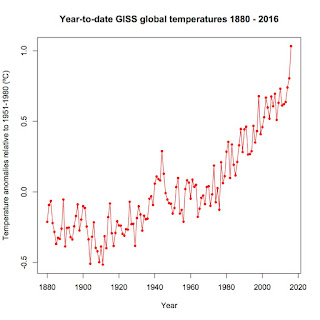
No, I'm not talking about the recently concluded US election that saw a scientific illiterate ascend to the presidency. Given the lack of details about Donald Trump's intended policies, it's impossible to say what, exactly, his election means for science in the US although I have doubts that it means anything good given his stated antithesis toward science, particularly climate science. I will instead focus on some significant events that have been eclipsed in the media frenzy around the presidential campaign. First up, global temperature. Has it been hot enough for you? Here are January through September temperatures for every year in the GISS record.  So far, 2016 has obliterated the previous record for January - September global temperature anomaly set in 2015, 1.03ºC to 0.80ºC. Not only is the average for the first nine months hotter but eight of those months are the hottest respective months on record, with only June 2016 (in third place) the lone non-record-sette...

James Taylor gets polar ice wrong—as usual

Image
James Taylor of the Heartland Institute had a piece on Forbes back in May that escaped my attention when it first came out.  Titled " Updated NASA Data: Global Warming Not Causing Any Polar Ice Retreat ", it focused on the single premise that since 2012, total polar sea ice was above the average since 1979.  Taylor then jumped to the erroneous conclusions that a) polar sea ice was not retreating and b) global warming will be entirely beneficial to humans.  His arguments are familiar, as I dealt with them before when a Newsmax article featured them back in 2014 .  He's recycling old talking points, so this post is going to echo the one I wrote a year ago.

Where is climate change headed?

Image
With the completion of yet another circle around the sun, it's time to take stock of where we're headed with global climate.  I'm going to do something that is somewhat risky—extend statistical models beyond the data range that was used to create them, but necessary if we want to see where current trends will take us in the future.

Seeing how well predictions for September Arctic sea ice did in 2014

Image
In August, I published a post listing predictions of what the average September sea ice extent would be in 2014 .  Since September 2014 is now past, we can go back and see how those predictions panned out.  First, here are the predictions again: Month Model R 2 Ice extent in 2014 (millions of km 2 ) Predicted Sept. ice extent (millions of km 2 ) Graph June -13.5300 + 1.6913x 0.7522 11.09 5.23 July -4.80933 + 1.18618x 0.8796 8.17 4.88 August -1.69389 + 1.12965x 0.9674 6.13 5.23

The Daily Fail: David Rose's newest cherry-pick.

Image
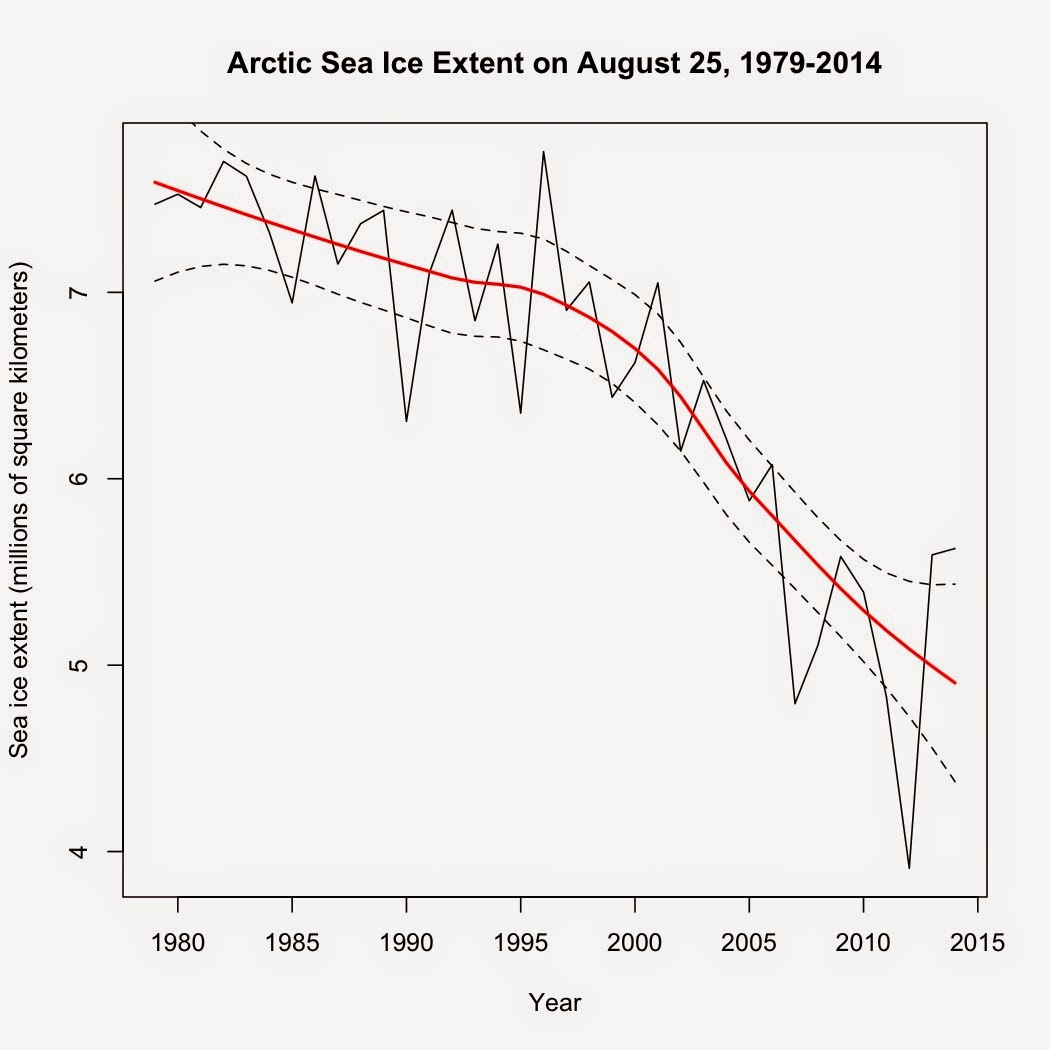
David Rose, who is no stranger to cherry-picking climate data and then weaving artful tales based on those cherry-picks, is back with yet another example of his perversity .  This time, he's trumpeting a 2-year increase in Arctic sea ice as measured on a single day: August 25, 2012 vs. August 25, 2014, claiming a 43% increase based on those two very specific days.  This is misleading for multiple reasons, one of which he himself admits in small type under that large flashy graphic at the top of his article: " These reveal that – while the long-term trend still shows a decline – last Monday, August 25, the area of the Arctic Ocean with at least 15 per cent ice cover was 5.62 million square kilometres." (emphasis added). So, just what does that long-term trend show? This:

How low will it go?

Image
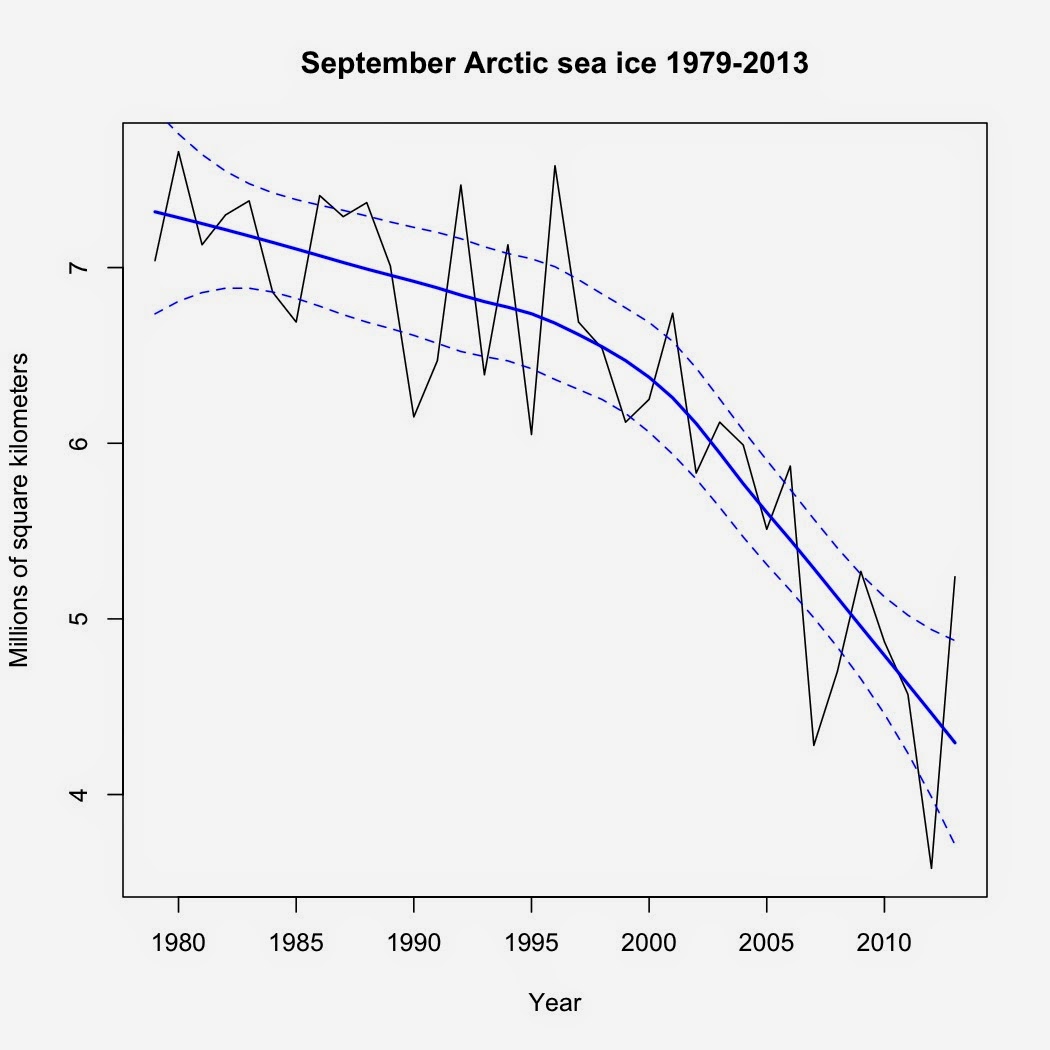
This is the time of year all eyes start turning toward the Arctic, specifically how rapidly and/or much the multiyear sea ice will melt this particular year.  Here is the average sea ice extent for September since 1979: I've added a loess regression line along with 95% confidence intervals to highlight the trend.  Despite last year's rebound from the 2012 low, the overall trend is decidedly down, with less multiyear ice remaining as time goes by. Now on to my prediction of what the ice will do this year.  What I did was simply to extrapolate based on the loess regression, which yielded a prediction of 4.135 million km 2 .  I also fitted a polynomial regression to the data, which produced a prediction of 4.085 million km 2 .  Both are well above the record low in 2012 (3.58 million km 2 ), showing how anomalous the 2012 low was.  If the loess curve holds, I wouldn't expect the trend to fall below the 2012 low until 2018. So, what is your prediction ...

Is it a requirement...

Image
for GOP politicians to be completely ignorant of science?  You have Phil Broun, a former physician who called evolution, embryology, and the Big Bang " lies straight from the pit of Hell ."  It's enough to make one wonder how he reacted to bacteria who have evolved antibiotic resistance and/or cared for any potentially pregnant patients, given that an understanding of embryology is rather integral to caring for such patients.  Then there's Ralph Hall, who claimed that climate scientists are essentially committing fraud for grant money , Dana Rohrabacher once claiming that dinosaur farts caused climate cycles in the past, and Phil Gingrey's claims that women's bodies can resist pregnancy arising from rape because a woman's body shuts down ovulation if she is stressed out.  Gingrey is a former OB/GYN.  Who believes that a woman's body can magically shut down its reproductive system if subjected to the stress of being raped....  My irony meter just broke....

2013 climate review

Image
2013 was notable in several ways, from the record warmth in Australia to the polar vortex that gripped the Eastern US in November and December due to a weakened Arctic polar jet stream and record drought in the US state of California, along with numerous extreme weather events around the globe .

Ignorance, blindness, and outright misinformation

Image
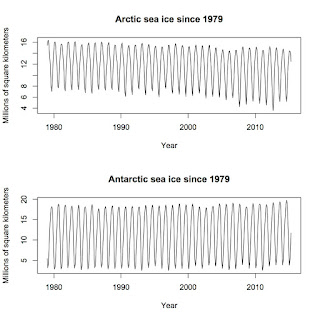
A childhood acquaintance on Facebook posted a link to a CBN News article that serves as a good example of what is wrong with conservative news media.  Written by Dale Hurd, it is a mash-up of science denier canards with little in the way of actual science or evidence. The first paragraph sets the tone, making fun of the scientists who were trapped in Antarctic ice.  Nowhere does Hurd mention HOW the scientists were trapped: A storm packed sea ice into the bay their ship was in.  Now this can happen at any time of the year but it doesn't mean that the ice is growing.  It's summer down in Antarctica, a time when Antarctic sea ice melts from ~19 million km 2 in September down to ~2-3 million km 2 by March.  That leaves plenty of broken pack ice for winds to blow around, especially in the early part of the melt season such as December when the ship was trapped.  So the irony is that those scientists were trapped by MELTING sea ice, an irony completely los...

Arctic sea ice past and present

Image
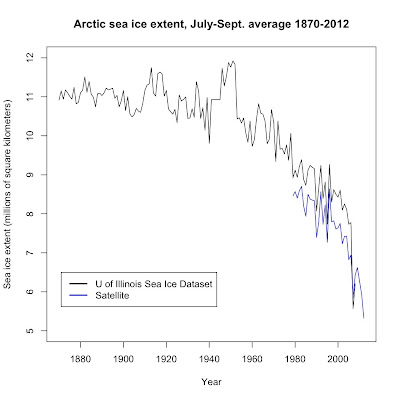
I've previously written about the recent changes in polar sea ice .  This post compares the current trends in Arctic ice with the previous century.  I've recently read several claims that the recent melting is matched by melting episodes in the 1920s and 1940s.  However, those claims are pure bunk.  Walsh and Chapman ( 2001 ) compiled records on Arctic sea ice extent since 1870 (updated data available here ).  I've graphed their July-September average, together with the July-September average measured by satellites since 1979: